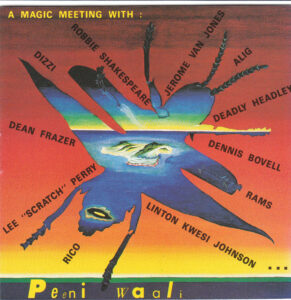
The Return of Peeni Waali
CD AGR 004

1) Nice Time (Fizzè) 4’54“ drums: Daniel Spahni / bass & guitar: Dennis Bovell / trombone: Rico Rodriguez / the captain: Lee „Scratch“ Perry / jodel: Ligia Godinez, Heinz Vetsch, Georg Steiner / tuba, euphonium, trombone & fluegelhorn: Shirley Hofmann / baritone, tenor & alto sax: Steve Gregory / hackbrett: Roland Schiltknecht / ukulele & vibrato guitar: Cédric Vuille / accordion: Tobias Morgenstern / balafon: Gilles-V. „Dizzi“ Rieder
2) (Hip) Hop Schwiiz! (Fizzè / T. Morgenstern) 3’19“ drums: D. Spahni / bass: Fizzè / darbouka: Dizzi / turntables: Maurice Nigg / beatbox: Philip Willi / accordion & clavinet: T. Morgenstern / hammond C 3 organ: Barbara Dennerlein / ukulele: C. Vuille / guitars: John Kpiaye
3) Game (Fizzè) 5’05“ drums: Leroy „Horsemouth“ Wallace / ukulele & bass: C. Vuille / guitar: Earl „Chinna“ Smith / trombone: Rico / fluegelhorn: Lukas Nüesch / sax: Philip Kunz / tenor sax solo: Steve Gregory / Hammond organ solo: Barbara Dennerlein
4) Afrinity (Fizzè) 3’58“ drums: D. Spahni / bass: D. Bovell / rythm guitar: C. Vuille / pick guitar: Fizzè / shaker & balafon: Dizzi / accordion: T. Morgenstern / tenor sax solo: Michael „Bammie“ Rose / hammond C 3 organ lead: B. Dennerlein / hackbrett: R. Schiltknecht / milkpots: Pascal Cuche / reeds: S. Gregory / tuba & bone: S. Hofmann
The Triptychon (15’32“):
5) Eve – for our mothers (Fizzè) 5’25“ drums: Leroy „Horsemouth“ Wallace / bass & pick guitar: D. Bovell / riddim guitar: Fizzè / electric lead guitar: J. Kpiaye / accoustic guitar: Rainer Rohloff / accordion: T. Morgenstern / fender rhodes: Stefan Kling / hackbrett: R. Schiltknecht / kanun: Hossam Shaker / panflute: Frank Mehlin / soprano sax & reeds: S. Gregory / euphonium & brass: S. Hofmann
6) Elemental (El Emmental) – for our fathers (Fizzè / C. Vuille) 5’27“ repeater & drums: „Horsemouth“ / bass, ukulele & guitars: C. Vuille / slide trombone: Rico / tuba, euphonium & valve trombone: S. Hofmann / violins: Helmut Lipsky / accordion: Tobias Morgenstern / alto sax & tenor sax solo: S. Gregory / harmonica: Marc „Nof-Nof“ Tourtchaninoff / soprano and alto sax solos: Dean Frazer
7) Sang Neuf – for our children (C. Vuille / Fizzè) 4’40“ drums: D. Spahni / electric bass, cuatro & guitars: C. Vuille / string bass: Sylvain Gagnon / kanun: H. Shaker / hackbrett: R. Schiltknecht / violins: H. Lipsky / accordion: T. Morgenstern / balafon, darbouka & djembe: Dizzi
8) Sleep Dub – (Strekosa’s Chant) (Fizzè) 4’30“ drums & perc: „Horsemouth“ / bass: Sydney „Juinior Dan“ Gossine / guitars: „Chinna“ / throat vocals of Altai & topshur: Nohon & Bolot / komus (jew’s harp): Bolot / clavinet: Dr. Pablo Black
9) Dream (Fizzè / Rico) 5’15“ drums: „Horsemouth“ / riddim guitar: „Chinna“ / bass & pick guitar: D. Bovell / trombone: Rico / reeds: S. Gregory / brass: S. Hofmann / vibraphone: Fizzè
10) Blues for Eddie Boyd (Fizzè) 5’03“ drums: D. Spahni / bass: D. Bovell / voice: Taj Mahal / milkpots: P. Cuche / spoons, darbouka & cabassa: Dizzi / lead & rythm guitar: J. Kpiaye / slide & pick guitars: C. Vuille / wah-guitar: Fizzè / reeds: S. Gregory 2nd tenor sax solo: „Bammie“ / trombone: S. Hofmann / hammond C 3 organ: B. Dennerlein / 2nd piano: Georgie Fame / messenger: Samuel „Balz“ Burckhardt
11) Rebirth (Linton Kwesi Johnson) 3’49“ drums: D. Spahni / bass: Linton Kwesi Johnson / pick guitar: J. Kpiaye / riddim guitar: Fizzè / soprano sax & flute solo: S. Gregory
12) Still Life (C. Vuille – arr. S. Gregory) 3’48“ drums, percussion & handclaps: D. Spahni / bass & handclaps: C. Vuille / alto & tenor sax: S. Gregory / trumpets: Hans Hämmerle / guitars: C. Vuille, Jean-Vincent Huguenin & Julien Baillod
13) Still Love (Alton Ellis) 4’13“ drums: D. Spahni / bass, riddim & pick guitars: D. Bovell / reeds: S. Gregory / brass: S. Hofmann / lead guitar: J. Kpiaye / hammond C 3 organ lead: B. Dennerlein
Bonus Gags (lite!):
14) Nice Time 2’50“ (the Radio Edit – short version)
15) Animals (Bob Dylan) 5’05“ vocal & programming: Fizzè
16) Lintus (Fizzè / T. Morgenstern) 3’07“ drums: D. Spahni / cello: Raphael Zweifel / bass, guitar & xylophone: Fizzè / percussion: Dizzi / accordion: T. Morgenstern
17) nomol eis…
Produced, arranged, recorded & mixed at Studio Mensch by Fizzè (flute, Hammond C3 organ, keyboards, bass, guitar, vibraphone & xylophone except where otherwise noted)
all songs c & p by Mensch Music except „Rebirth“ published by LKJ Music Publishers Ltd., „Animals“ & „Still Love“ are copyright control
More Info
in 1997 – catalogue number: CD AGR 009
After I finished „The Dawn of Peeni Waali“ I had already quite a lot of material together and brooded over how to put the stake higher but continued to work in the same vein. Naturally, the ‘old contacts’ came in as a new starting point / platform.
Every meeting with a new musician meant another pleasurable anecdote. No single ‘rent a player’ really occurred. It was always more like an invitation of respect to become a party of fun and joy to record with. At the same time, I became involved in a lot of ‘side-productions’ that fuelled new aquaintances. I became more self-assured to approach people and eventually, the musicians took a liking to come over to Switzerland and record in ‘hedonistic conditions’.
e.g. I wanted to do a blues rendering in tribute to my musical mentor Eddie Boyd (a blues singer from Mississippi with whom I grew up). However, Eddie passed away before we’d finish the tune. While I was recording the bass with Dennis Bovell, I told him the original plan and mentioned on the side, that I’d have to abandon the idea, because the only voice that could ‘substitute’ Eddie – if ever – would be someone like Taj Mahal. Now Dennis being good friends with Taj, count two and two… Next time, Taj toured in Switzerland he came over and the blues was in the can…
Getting to know LKJ better through the years, naturally I met the players from the band, e.g. Steve Gregory who in turn was to become the backbone in terms of reeds for many recording session here (not to mention that we share the same birthday!). Steve introduced me to his old friend Georgie Fame, who plays with Van Morrison as much as Steve did. The link wasn’t so farfetched, because Georgie was also the first British guy to play with Rico as far back as 1962…
Listening back to the organ takes of Georgie Fame, I thought, the stake could be put even higher, so I called Barbara Dennerlein. We’d set the logistics and a few days later, Barbara came over and blew me away by not only being an extraordinary player, but also a very charming, wit, fun to work with (and beautiful) woman.
When I mixed the Cairo band ‘Sharkiat’ – then hosted on the rootsical Swiss label Face Music of U.-A. Wethli – , I’ve got to know the kanun player Hossam Shaker. During his stay he was curious to hear what kind of music I’m doing, so I played him some raw tunes. He took to it immediately, improvised to it for fun and of course, I didn’t take me long to mike him up and he joined the party with another colour, another exotic touch (sic).
While recording another album – also for the Face Music label – of Bolot & Nohon from Altai, the same thing happened. They were curious to hear some of my stuff. I suggested they’d bring in their throat vocals on the one harmony riddim „Sleep Dub“ to accentuate even more the monotony but enhance the trance-like feeling you can come into with simplicity. „Strekosa’s (Peeni Waali in Altai language) Chant“ was also a welcome change to all the complicated scoring and intricate musical structures of most of the other tunes.
Sometimes we have to work for vein patrons; people who believe – because they have money, they can take any liberty, know everything, are allowed any grossness.
One of such producers (sic) produced (more sick) his singing house-wife; an ill-fated project. On this to be ‘mainstream pop production’, I had to cast a set of skilled accompanying musicians which I found in the trio L’Art de Passage from Berlin who backed Swiss troubadour Linard Bardill at the time. The meeting and working with Rainer Rohloff (guitar), Stefan Kling (piano) and Tobias Morgenstern was a revelation for all of us! The relations with these brilliant musicians and nice people made us quickly forget the initial bad trip of having to work for money-spoiled producers. We’d rather enjoy the synergies of meeting people – a task specifically affiliated to making music, don’t it?!
With Tobias, I also found a ‘mental brother’ who understood, what Mensch means. Tobias immediately took to the idea of exchange and it wasn’t all too surprising, that Morgenstern’s first solo-album was soon done at Mensch.
Getting to use accordion so extensively, I glanced in the direction of other ‘typical’ Swiss instruments such as hackbrett. Although it took me almost 2 years to convince Roland Schiltknecht, a local Hackbrett player, to participate on some tracks and in exchange, I’d mix and release his own venture „Tunsch“. 10 years later we teamed up as „Peeni Waali vs. Schildpatt“ (or the Schildpatt posse vs. the Peeni Waali posse) within the album SHA .
To integrate local colour, a guitar-playing neighbour joins in: Hubert Osterwalder with whom I soon started a long-lasting teamwork on many musical journeys, e.g. the great R’n’B band Gumbo.
And yet another fantastic player joined the round while he was here for another project: violinist Helmut Lipsky from Montreal, Canada. Highly skilled, classically trained (a pupil of Izaak Perlman), Lipsky’s talented enough to stand above any prejudice of any kind of music and even accepted to fiddle!